Own a slice of Malaysia at play.
PlayTown Rawang is Malaysia's first integrated 187,100 sq ft family campus — four zones under one gate at RM 40 blended spend per visit. Anchored by Lowyat Group. Opening 2H 2027.
now open
The energy state we're building for.
Five scenes from the target venue. All zones, same family, one weekend.
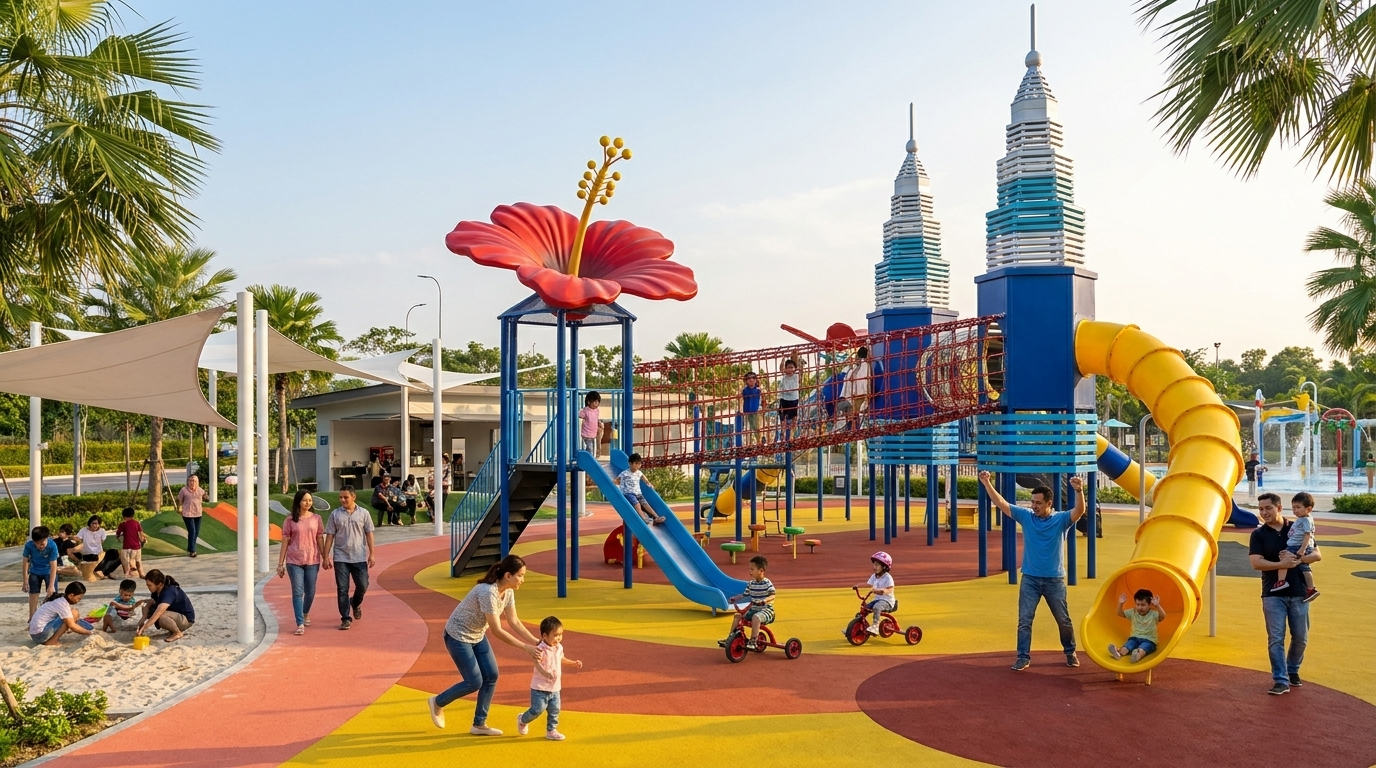
The KLCC silhouette, kid-scale.
Twin Towers + Bunga Raya secondary climber.
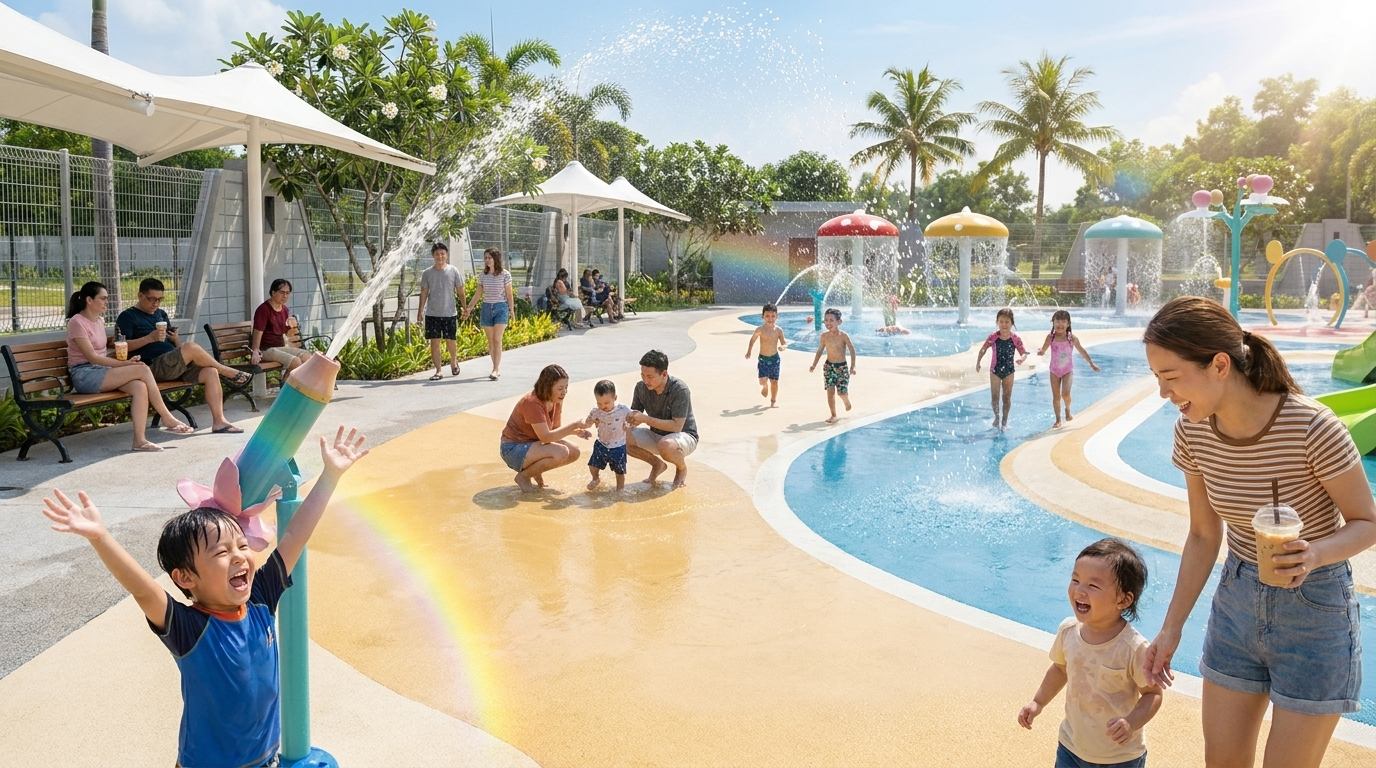
Lotus cannons. Cream wave floor. Joy.
Slot-based access. Parents stay dry. Kids do not.
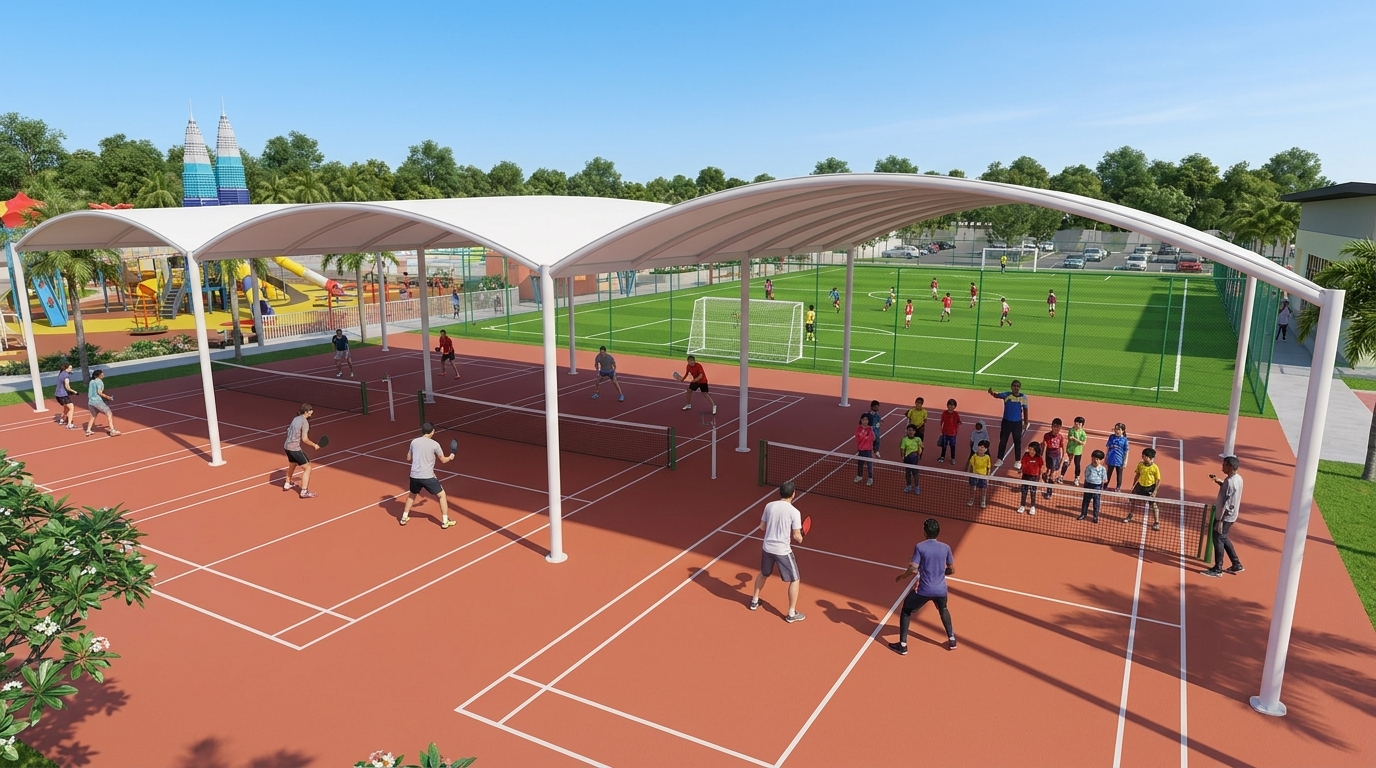
Three generations, same court.
5 pickleball courts + mini football.
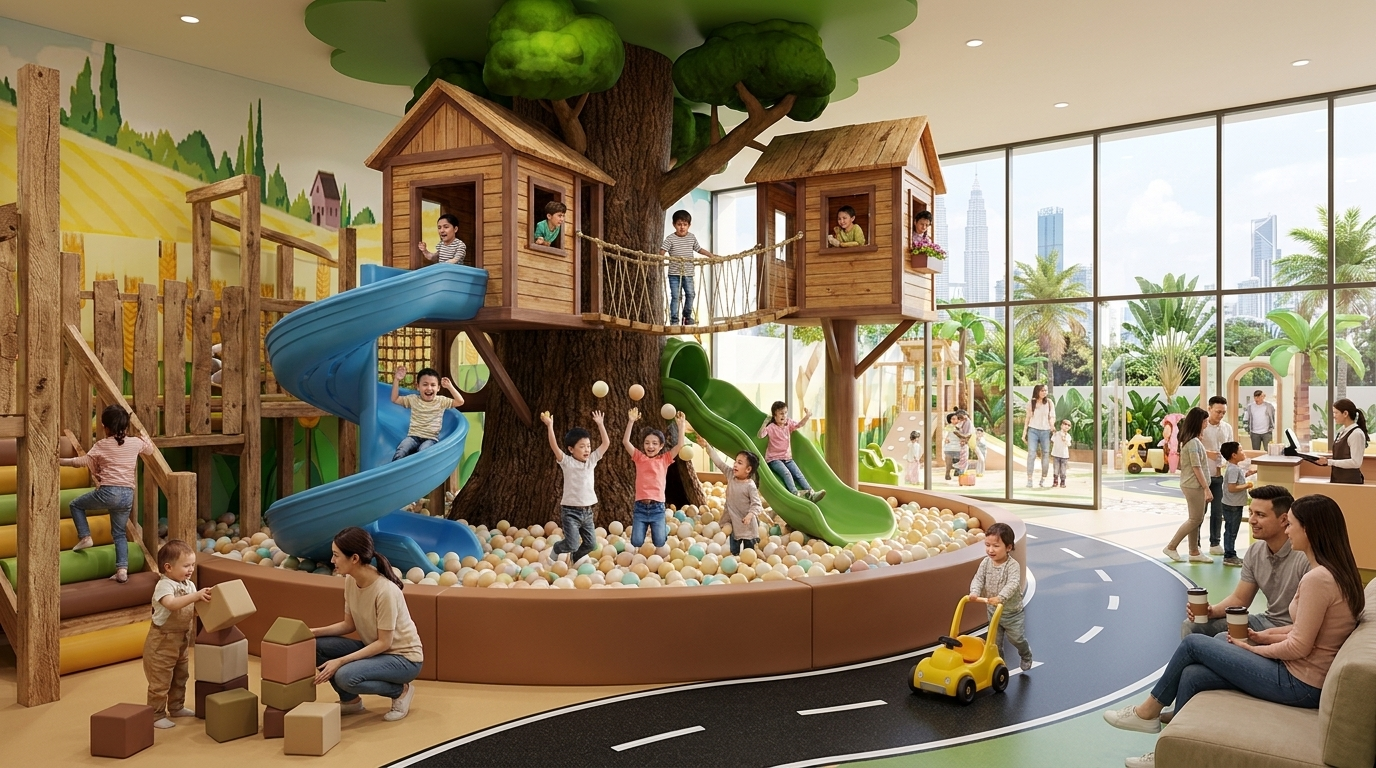
Treehouse, ball pit, glass to outdoor.
4,000 sq ft kampung soft play.
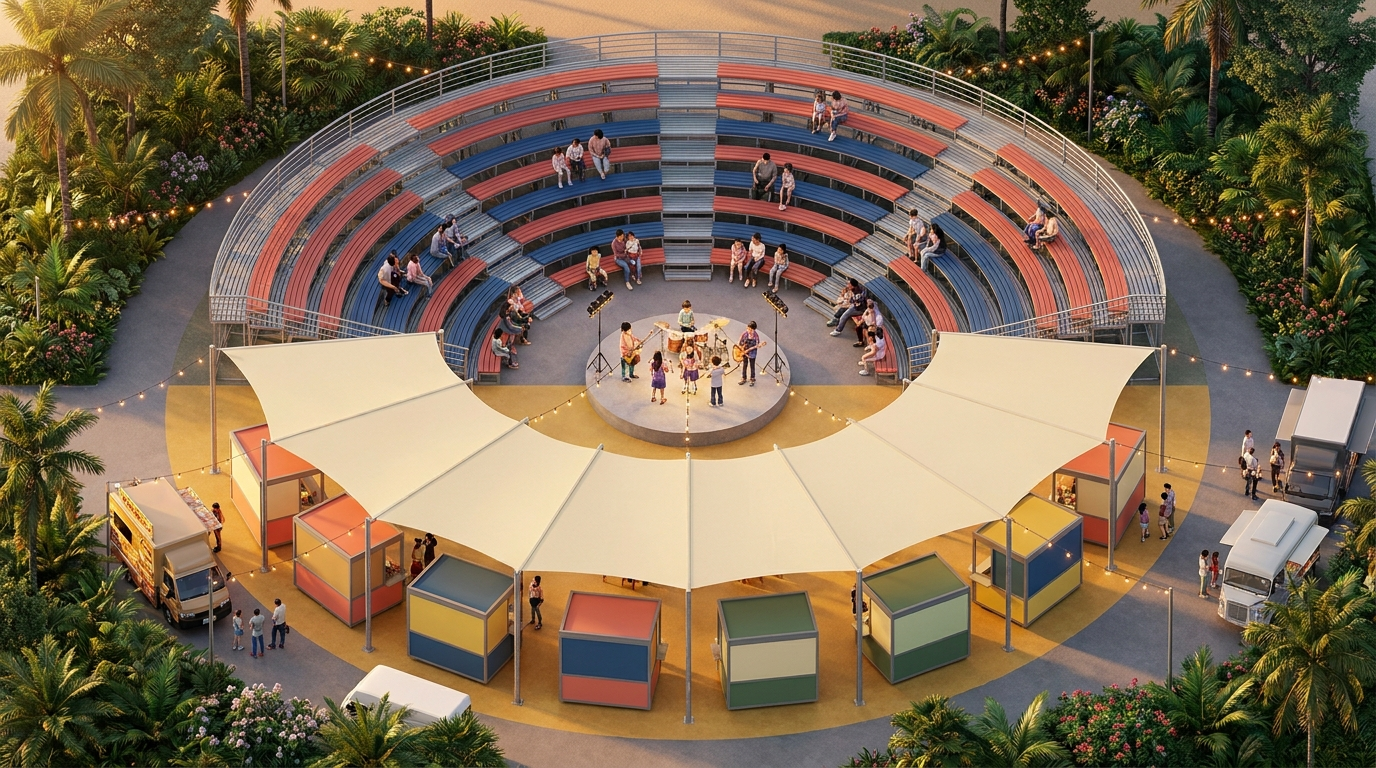
Day ends, the band starts.
Steel-stack stage. 8 food stalls.
Anchored by Lowyat. Sized for 130,000 families.
The site
- LocationBandar Tasik Puteri, Rawang
- Area187,100 sq ft
- LandlordLowyat Group
- Soft launch2H 2027
- ContractorPembinaan LNS (CIDB G6)
Lowyat Group's commitment: RM 6m upfront site infrastructure + PlayTown memberships bundled into 600–1,000 new residential units/year over the lease — built-in demand pipeline.
The catchment
- Families within 30-min drive130,000
- Catchment population (DOSM 2020)~600,000 people
- Family capture at Y720% = 26,000 families
- = Person-visits per year166,000
- Blended ARPU per visitRM 40
- Destination-park benchmarks~20–65%
| Destination-park benchmark | Family capture |
|---|---|
| Sunway Lagoon | ~25% |
| Lost World of Tambun | ~65% |
| Legoland Malaysia | ~25–30% |
| Berjaya Times Square TP | ~20% |
| PlayTown Y7 target | 20% |
Selangor median household income RM 13,296/month — highest in Malaysia. ARPU = Average Revenue Per User. Catchment and capture are Issuer estimates on DOSM public data, not independently verified; benchmarks are Issuer-compiled approximations from operator filings and press.
How big is the market? · TAM → SAM → SOM
PlayTown's Y7 Rawang venue revenue of RM 6.7m (Facility RM 4.9m + Other RM 1.77m) is ~19% of primary SOM and ~7% of combined SOM.
How we calculate this
SAM — Indoor FEC ~RM 200M (IMARC 2024) + Theme & Water Parks ~RM 500–700M (Bursa operator filings, Legoland estimate) + Sports Facilities ~RM 500–800M + Family Recreation ~RM 300–500M (Issuer-modelled); range RM 1.5–2.2B, ~RM 2.0B midpoint.
SOM — Primary: ~600,000 people within 30 min of Bandar Tasik Puteri (DOSM Census 2020) × ~RM 58/person (SAM ÷ 34.3M population) ≈ RM 35M. Accessible: ~3M Klang Valley residents within 45–90 min × ~RM 20/person destination-only spend = RM 60M. Combined ≈ RM 95M.
SOM and catchment are Issuer estimates on DOSM public data, not independently verified.
Proximity proof · Star Market (right beside PlayTown)
- Star Market footfall111,000 / month
- That's per year~1.33 million visits
- Average basket per transactionRM 66
- PlayTown Y7 target vs that trafficjust ~12.5%
Next door already proves the traffic. PlayTown's Y7 target of 166,000 person-visits is ~12.5% of what Star Market draws from the same families today — real operator numbers, not a model. Source: Datuk Seri Jeffrey Tan, Star Market founder, 26 Aug 2026.
Corridor validator · Coalfields Retail Park (11 min south)
KLK Land opened Coalfields Retail Park (CRP) on 10 Sep 2026 — 1 million sq ft, 11 minutes south, underwritten on KLK's own estimate of ~1 million people within 20 minutes. CRP's indoor play is premium-tier (Harborland, RM 64/head/3.5 hr); PlayTown is the wet-play + sports campus the corridor lacks, at RM 40 blended. One corridor, three anchors: Star Market (grocery) + CRP (retail + entertainment) + PlayTown (wet + sports, 2H 2027).
The structural moats. Honest weather.
One entity, four ways to get paid.
Rawang is engine one. Events (already live via MetaHub), royalties from partner-operated sites and owned Sites 4–6 stack on top — one company, one balance sheet, one share class. A slow year in one engine; three others keep the cash flowing.
Malaysian rain is real — we built for it, not against it.
Light rain: ~12,000 sq ft of tensile-canopied outdoor. Thunderstorm: 4,000 sq ft indoor kampung holds 25–30 families. The model books rain days at ~30% of dry-day revenue on ~25% wet weekends. Members get free re-entry within 30 days for any visit cut short — a retention mechanic that defers demand, not a recovery of same-day revenue. Open through the rain; not weather-proof.
RM 40 ARPU. Weekly visits, not once-a-year.
Others price RM 100–200/visit for annual occasions. PlayTown: ~RM 40 blended (admission RM 29 + F&B RM 7 + retail RM 4), built for weekly repeat. Membership builds habit, not one-shot purchases.
Demand built into the lease.
Lowyat Group bundles memberships into 600–1,000 new homes/year in the catchment. A partnership new entrants cannot replicate.
Portable demand. Programming IP. Commercial lock-in.
Demand: MetaHub organizer, academy, coach, school and corporate relationships — Ken arrives with demand. Operating: league formats, tournament scheduling and camp programmes refined over 6 years. Commercial: revenue share on family spend + turnkey event ops + subsidised venue hire — organizers can't run a better event elsewhere. A decade's head start on Day 1.
Family-recreation has a graveyard. Here's why we avoid it.
Each closure had a structural cause. PlayTown's architecture is the answer to each.
From seed round to Bursa ACE.
Two steps, one listing path: LEAP Market admission at Year 3 (governance only — no raise, no dilution), then a Transfer of Listing to the ACE Market at Year 5 (FY2032) — the liquidity event. Per the Bursa Malaysia ACE Market Listing Requirements; admission to either market is subject to Bursa Malaysia and Securities Commission approval.
Fund raise open
Rawang opens
LEAP Market admission
Transfer of Listing to ACE Market
Sites 4–6 open
What you'd actually get back. Slide your ticket.
Same 12-year model as the Sophisticated brief, simplified. Pick a ticket and a scenario. Talk to Ken to underwrite the assumptions in detail.
| Exit | What you get |
|---|---|
| Sell at ACE · Y5 | Post-float stake × (scenario P/E × Y5 core PAT RM 2.98m). Pure equity sale. |
| Hold to Y7 | Pro-rata share of distributable cash Y1–Y7 (RM 18.78m company-level) + equity at the same P/E on Y7 consolidated PAT RM 5.60m (Sites 4–6 contributing). No re-rate assumed. |
| Scenario | P/E | Y5 mcap | Why |
|---|---|---|---|
| No listing | — | — | ACE Y5 doesn't happen. No dilution, no liquid exit; full 12-year distributable cash pro-rata. Illiquid equity, dividends still flow. |
| Base | 13.4× | RM 40m | Below Genting Malaysia's 14× LTM (GENM) and the FEC peer-set Q1 15.8× (Songcheng 19.5×, Round One 18.8×, United Parks 12.9×); matches the TCC Capital valuation (Sep 2026). Y7: RM 75m on PAT RM 5.60m → 7.24× MOIC / ~32% IRR at the RM 6m target raise. At max RM 7m raise: 6.59× / ~31% IRR — the extra RM 1m OS issued at max adds 1M shares to the cap table, slightly diluting each investor's % of the company (Y7 MCAP is fixed by PAT × P/E, not raise size). The round is priced against this. |
| Upside | 20× | RM 60m | In-band pricing if pre-listing demand books well. |
Distributable cash build-up: RM 4.7m by end-Y4 · RM 8.4m by end-Y5 — passes the RM 7m raise before the targeted ACE listing, independent of the multiple. Company-level cash available for distribution, not amounts committed or paid to investors; distributions subject to Board declaration and Companies Act 2016 S.131. RPS terms: see the card above.
Liquidity: Bursa's standard 6-month moratorium applies to promoter and pre-listing shares after the Y5 ACE listing — plan on a post-moratorium exit, not listing-day cash-out.
Not a guarantee. Projections only. Pre-revenue family-recreation ventures carry substantial risk including total loss of capital. Full derivation: Scenario Derivation · Sophisticated.
One raise, transparently.
RM 7m, one entity, one price. One MyStartr ECF campaign, two instruments. Same share class and price for every ordinary-share investor. Closes 30 November 2026.
Talk to Ken. Directly.
Email Ken directly — real numbers, no intermediary. Investor pack and subscription mechanics walked through one-to-one.
Want the deeper financial dive?
Four revenue engines, the full cap table, the LEAP → ACE thesis at 13.4× and the failure-mode analysis.